Choosing Aluminum Glass Door Hinges in 2026 requires more than matching a hinge to a stylish glass panel. The correct choice depends on glass thickness, door weight, opening frequency, frame alignment, and installation conditions. A hinge that looks elegant in a showroom may sag when exposed to daily traffic, temperature changes, or uneven floor levels.
Architectural hardware consultant Michael R. Lawson explains, “A reliable glass door hinge is selected by load, movement, and installation detail—not appearance alone.” This practical view matters when comparing stainless steel, aluminum, and coated hinge bodies. It also reminds buyers to inspect screw quality, gasket design, adjustment range, and corrosion resistance. Small details matter.
Some decisions remain less obvious. A concealed hinge may create a cleaner appearance, but it can complicate maintenance. A self-closing model may improve convenience, yet excessive closing force can stress the glass edges. Not every attractive product fits every entrance. That is easy to forget.
This guide examines how to choose Aluminum Glass Door Hinges for modern residential, commercial, and hospitality projects. It considers door dimensions, glass weight, hinge capacity, finish durability, safety requirements, and installation accuracy. It also addresses common selection mistakes, including relying on nominal weight ratings or ignoring the surrounding frame. A careful installer may measure twice and still discover an alignment issue later. That is not failure; it is useful feedback. The best hinge is not simply the strongest or most expensive option. It is the component that supports smooth movement, stable positioning, safe operation, and long-term service in its actual environment.
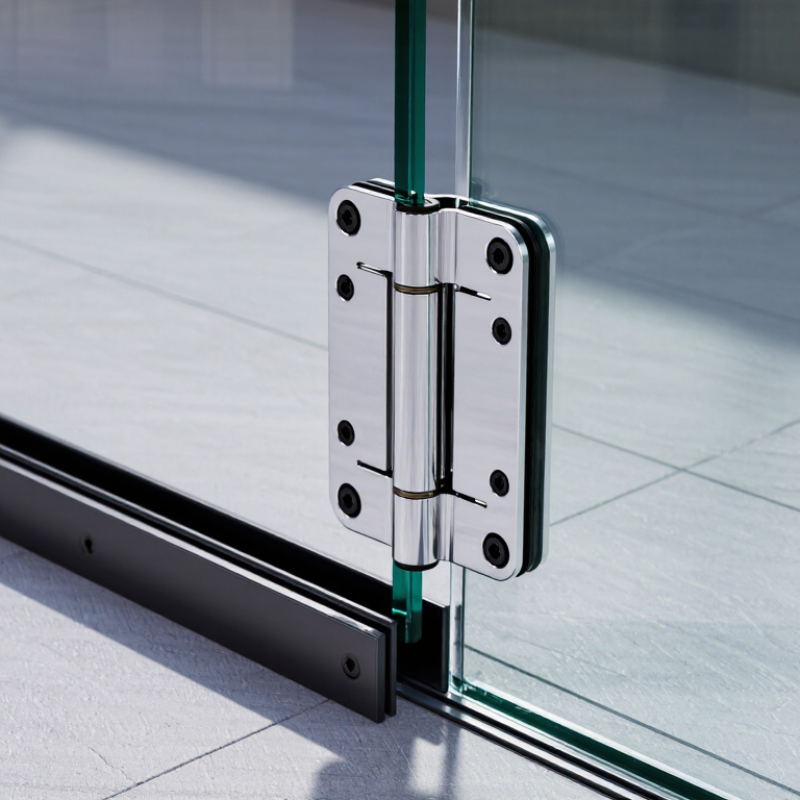
Aluminum glass doors use several hinge types, and each suits a different installation. Glass-to-glass hinges connect panels in shower rooms, offices, and retail partitions. Glass-to-wall hinges attach a door to masonry, tile, or an aluminum frame. Pivot hinges support a central or offset rotation, giving wider openings for entrances. Butt hinges suit framed doors where the aluminum profile carries most of the load.
Application changes the decision. A compact office door may need a concealed, self-closing hinge. A busy entrance needs adjustable closing speed, corrosion resistance, and tested cycle durability. The U.S. Energy Information Administration’s 2018 Commercial Buildings Energy Consumption Survey counted about 6.2 million commercial buildings. That scale shows why standardization matters, but identical doors rarely experience identical traffic. Measure the glass thickness, door width, total weight, opening angle, and frame condition before selecting hardware.
Thermal and maintenance details deserve attention. The 2024 Global Status Report for Buildings and Construction states that buildings consume about 32% of global energy and produce roughly 34% of energy-related carbon emissions. A hinge does not control building performance alone. However, poor alignment can prevent proper closing, increase air leakage, and create repeated service calls.
I once focused too heavily on load rating. That was incomplete. Fasteners, gaskets, drainage, and installation tolerance can matter just as much. Choose hinges tested for the actual glass configuration, not only attractive product dimensions.
How to Choose Aluminum Glass Door Hinges in 2026?
Measure Door Weight, Thickness, and Hinge Load Requirements
Choosing aluminum glass door hinges starts with measurements, not appearance. Weigh the complete door leaf after installing glass, seals, handles, and locks. A bare panel can mislead you. Record width, height, and thickness with a steel tape and caliper. Measure the frame wall thickness too. This detail affects screw engagement and hinge compatibility.
Calculate load per hinge using total door weight and the hinge arrangement. Two hinges do not automatically share weight equally. The upper hinge often carries greater stress, especially on tall doors. Check the published hinge load rating, adjustment range, and approved glass or frame thickness. Select capacity above the measured load, with a sensible margin for repeated opening and accidental pulling. Do not divide the weight blindly. Ask a qualified installer to verify heavy or frequently used doors.
For an aluminum-framed glass door, test the hinge position against the frame profile. A hinge may fit the glass but collide with a seal, screw channel, or threshold. Confirm that fasteners match the frame material and remain tight after adjustment. I once trusted a nominal thickness and overlooked powder-coating buildup. The hinge aligned poorly. Small errors matter. Use the installation sheet, inspect clearances, and recheck sag after several opening cycles. If measurements conflict, stop and measure again before drilling.
Compare glass thickness, estimated door leaf weight, and the recommended total hinge load capacity. The reference door size is 900 × 2100 mm, with an estimated 15 kg aluminum frame and hardware allowance.
Glass weight is calculated using a glass density of approximately 2,500 kg/m³. The recommended total hinge load capacity is set at twice the estimated door leaf weight to allow for normal operating forces. Select hinges by checking the individual hinge rating, door thickness compatibility, installation method, and site conditions.
How to Choose Aluminum Glass Door Hinges in 2026?
Choose Materials, Finishes, and Corrosion Resistance Levels
Material selection starts with the installation environment. For sheltered interiors, anodized aluminum can provide a clean appearance and stable surface hardness. Wet rooms need more caution. Stainless steel components, especially 316 grade, usually resist chlorides better than 304 grade. However, “stainless” is not automatically corrosion-proof. Scratches, trapped water, and poor cleaning can still create staining.
Finish quality matters as much as the base metal. Anodizing should be even, without cloudy patches or exposed edges. Powder coating offers color flexibility, but damaged areas may allow corrosion underneath. PVD finishes can look refined, yet their performance depends on preparation and coating thickness. I would inspect hinge edges, screw seats, and glass contact zones first. These small areas often fail before the visible face.
Corrosion resistance should match the site, not the brochure. ISO 9223 classifies atmospheric exposure from C1 to CX, covering mild indoor conditions through extreme marine and industrial environments. The NACE IMPACT study estimated global corrosion costs at about 3.4% of worldwide GDP. That figure explains why cheaper hinges can become expensive replacements. ASTM B117 salt-spray results can help compare finishes, but they do not perfectly predict outdoor service life. I would request test hours, coating thickness, and fastener compatibility. Still, supplier data needs questioning. A polished hinge may look excellent on installation day, then disappoint beside salty air.
| Hinge Material | Typical Finish | Relative Corrosion Resistance | Recommended Environment | Main Advantages | Important Limitations | Selection Guidance |
|---|---|---|---|---|---|---|
| 304 Stainless Steel | Brushed, polished, satin, PVD-coated | High | Interior areas, offices, residences, and normal-humidity commercial spaces | Good strength, widely available, attractive appearance, and dependable general-purpose performance | Less resistant to chlorides and salt exposure than 316 stainless steel | A practical default for most indoor aluminum-framed glass doors when the hinge is correctly isolated from dissimilar metals |
| 316 Stainless Steel | Brushed, polished, satin, PVD-coated | Very high | Coastal locations, marine-influenced areas, pools, spas, and frequently wet environments | Improved resistance to pitting and crevice corrosion because of its molybdenum content | Higher material cost; still requires cleaning and proper installation in severe salt exposure | Choose when salt, chlorine, condensation, or frequent water contact creates a higher corrosion risk |
| Anodized Aluminum | Clear, bronze, black, or custom anodized colors | Medium to high | Lightweight interior doors and aluminum systems where matching appearance is important | Low weight, good visual compatibility with aluminum frames, and a durable oxide surface | Lower wear and load margin than many stainless-steel designs; finish can be damaged by harsh chemicals or abrasion | Use only when the hinge design and load rating are suitable for the glass size and door frequency |
| Zinc Alloy with Protective Coating | Powder coating, electroplating, or decorative plated finish | Medium | Dry indoor applications with moderate traffic and limited moisture | Allows complex shapes, smooth decorative finishes, and competitive pricing | Exposed scratches or coating defects may allow corrosion; generally unsuitable for persistent wet or marine conditions | Select only with a documented coating specification and an appropriate indoor service environment |
| Brass | Polished, satin, lacquered, or PVD-coated | Medium to high | Interior architectural and decorative installations | Distinctive appearance, good machinability, and suitable strength for many interior hinge applications | Finish may tarnish or wear; some cleaning chemicals can damage lacquer or plating | Choose for design-led interiors where regular cleaning and finish maintenance are acceptable |
| Black or Colored PVD Finish | Applied over compatible stainless steel or another specified base metal | Depends on base metal | Interior projects requiring a coordinated architectural color scheme | Hard decorative surface, consistent color, and strong visual coordination with frames and handles | The coating does not eliminate base-metal corrosion; edges and damaged areas remain vulnerable | Evaluate the substrate first, then confirm cleaning instructions and finish durability requirements |
| Powder-Coated Metal | Matte, satin, textured, or custom color | Medium to high | Indoor and sheltered outdoor locations, subject to coating quality and substrate | Broad color choice, good appearance, and additional barrier protection | Chips, cut edges, poor pretreatment, and trapped moisture can reduce service life | Request coating pretreatment details and inspect vulnerable edges before outdoor use |
| Plastic or Polymer Bushing Components | Usually concealed inside a metal hinge assembly | Corrosion-free component | Any environment when used as an internal bearing or isolation component | Reduces metal-to-metal friction and can electrically isolate dissimilar metals | Not a substitute for a corrosion-resistant load-bearing hinge body; temperature and wear limits vary by polymer | Verify compatibility with the hinge load, operating temperature, lubrication requirements, and glass-door cycle count |
Opening angle should match the room, not just the product label. A 90-degree hinge suits narrow corridors and protects nearby walls. A 105-degree model gives easier access without demanding much clearance. For wide entrances, a 135-degree opening may improve movement. Check the real stop position after installation. A claimed angle can change with seals, frames, or uneven floors.
Adjustment features matter during fitting and later maintenance. Look for vertical, horizontal, and depth adjustment. These controls help align the glass when small gaps appear. They also reduce pressure on seals and prevent scraping. Adjustable closing speed is useful in busy spaces. Still, too much closing force can stress the glass. I would test the door repeatedly, not trust one smooth opening.
Safety performance deserves closer attention than appearance. Select hinges rated for the door’s actual glass size and weight, with a clear safety margin. Check clamping surfaces, anti-drop protection, corrosion resistance, and compatible safety glass requirements. A hinge should hold the panel firmly without crushing its edges. Small installation errors can create large problems. An experienced installer should inspect screws, gaskets, clearances, and movement after fitting. No hinge is perfect for every doorway. Rechecking the setup after several weeks is sensible.
How to Choose Aluminum Glass Door Hinges in 2026?
Verify Installation Compatibility, Maintenance Needs, and Product Quality
Choosing aluminum glass door hinges starts with accurate site measurements. Check the door thickness, glass weight, frame profile, opening angle, and hinge cutout dimensions. A hinge may look suitable but fail when its fixing holes miss the internal frame support. Confirm the allowable load with a safety margin, not just the door’s listed weight. Glass doors punish small errors.
Inspect the installation surface carefully. Aluminum frames can have thin walls, while reinforced sections provide stronger screw engagement. Use compatible fasteners and isolating washers to reduce galvanic corrosion between dissimilar metals. The hinge should close smoothly without forcing the glass or twisting the frame. I once approved a fitting based on appearance alone; alignment problems appeared after several weeks. That mistake reinforced the value of a dry test before final tightening.
Maintenance needs should match the building environment. Coastal air, pool chemicals, and heavy traffic can accelerate corrosion and loosen moving parts. Look for a protected finish, a replaceable pin, clear adjustment points, and accessible screws. Clean the hinge with mild soap and water, then inspect it for play, noise, or uneven closing. Avoid harsh abrasives. Product quality also depends on consistency: examine casting edges, thread accuracy, gasket fit, and packaging damage. Request load-test information or installation instructions when available. Some details remain easy to overlook. That deserves another check.