China Top 10 Full Extension Drawer Slides Suppliers
Choosing Full Extension Drawer Slides involves more than comparing prices or product photos. Buyers need to know whether a slide travels smoothly across its full length, supports the intended load, and fits the cabinet’s available space. Small details matter: a mounting hole shifted by a few millimeters can complicate installation, while an unclear load rating makes product comparisons unreliable. This guide introduces ten suppliers in China and highlights practical points to check when evaluating them. A top-ten list is a starting point, not a verdict.
Supplier capabilities can differ in materials, slide thickness, surface finish, extension options, and soft-close compatibility. Request current drawings and specifications, then confirm load ratings, test conditions, sample availability, minimum order quantities, and production lead times directly with each supplier. Ask how dimensions are inspected and how changes are communicated between sample approval and bulk production. Where certifications or test reports are important, verify that documents apply to the exact product being considered. Details like these help separate a polished catalog from dependable manufacturing support. Still, a single sample cannot predict every production run. That is worth remembering. The following overview offers a structured starting point for sourcing teams, importers, and furniture manufacturers comparing Chinese suppliers. Use it to shape questions, validate claims, and identify which partners merit a closer review.
Understanding Full Extension Drawer Slides and Their Applications
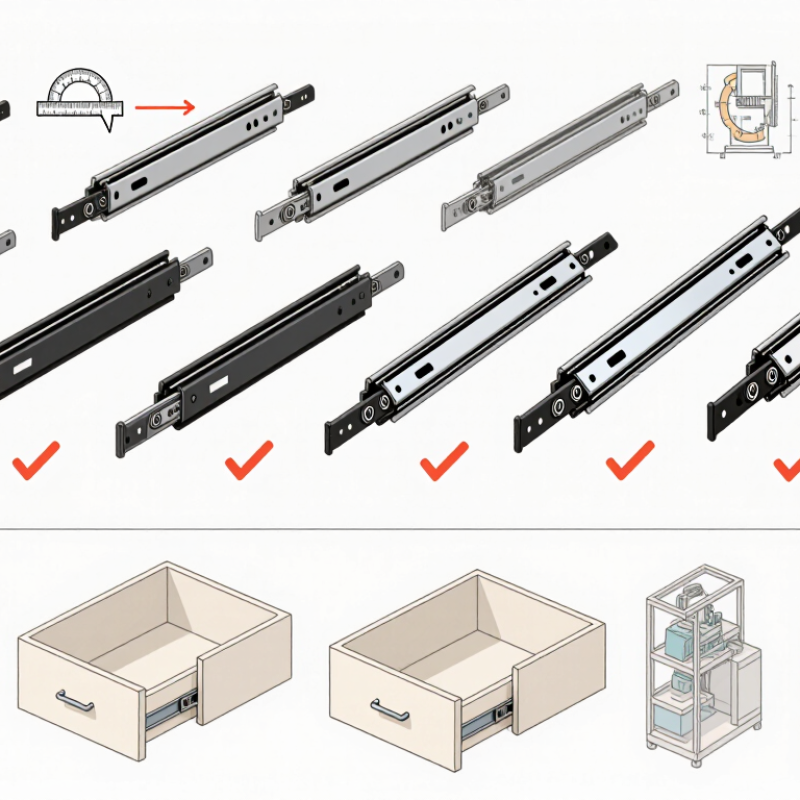
Full extension drawer slides allow a drawer to travel almost its full length beyond the cabinet opening. This makes items at the back easier to reach. In a kitchen, that might mean lifting out a heavy pot without removing smaller pans first. In a workshop, it can bring a tray of hand tools into clear view. Small detail, big difference.
“Full extension” describes travel, not strength or durability. Buyers should check the slide’s rated load, drawer width range, material, and installation requirements. A rating may assume an evenly distributed load, while real drawers often carry weight toward the front. That assumption can be wrong. For cabinet makers comparing suppliers, ask how product dimensions and load performance are checked across production batches. Measure the cabinet opening and drawer carefully; even a small mismatch can cause binding. Samples matter. Test a loaded drawer through repeated opening and closing, and listen for scraping or uneven movement. Some applications need secure, smooth access more than maximum extension, so choose based on the drawer’s contents and daily use.
Common Full-Extension Drawer Slide Lengths
These common nominal lengths are shown in inches, with millimetre equivalents calculated by conversion. A full-extension slide lets the drawer open approximately the length of the slide, providing access to most of its interior. Check the specific product’s dimensions and cabinet-depth requirements before choosing a size; availability varies by supplier.
How China’s Drawer Slide Supplier Market Is Structured
China’s full-extension drawer-slide market is not one uniform factory base. It is a layered supply network of component makers, slide assemblers, exporters, and trading companies. Some factories roll and punch steel in-house; others source rails, bearings, and finishes from partner workshops. That difference affects lead times, customization, and quality control.
Suppliers often compete on more than price. Buyers compare slide length, closed thickness, load rating, extension smoothness, and corrosion resistance. A useful sample check includes mounting-hole alignment, rail noise, and movement under a realistic cabinet load. Ask how the stated load rating was tested, and whether production batches receive the same inspection. Small details matter.
The market can be hard to read from a catalog alone. A trading company may offer broad options, while a specialized factory may handle a narrower range with tighter process control. Neither model guarantees better results. The picture is not perfectly tidy. Product specifications can also vary between samples and bulk orders, so approved samples and written tolerances help reduce surprises. Buyers should verify factory capability, test documentation, packaging standards, and communication before placing large orders. One point is easy to miss: reliable supply depends on repeatable production, not just an attractive first sample.
Profiles of 10 Chinese Full Extension Drawer Slide Suppliers
China’s full extension drawer slide market includes suppliers with different strengths. These ten profiles offer a practical starting point for comparing capabilities, rather than verified rankings.
Supplier 1 focuses on ball-bearing slides for kitchen cabinets and office storage.
Supplier 2 offers heavy-duty models for wider drawers.
Supplier 3 emphasizes soft-close mechanisms, where smooth movement matters.
Supplier 4 serves buyers seeking slim profiles for compact furniture.
Supplier 5 provides several mounting options, including side-mount and undermount designs.
Supplier 6 concentrates on standard sizes for repeat orders.
Supplier 7 supports custom lengths and load requirements.
Supplier 8 highlights corrosion-resistant finishes for humid rooms.
Supplier 9 offers matched components, such as locking devices and brackets.
Supplier 10 may suit buyers who need flexible order quantities.
Check details carefully.
Before choosing, request dimensional drawings, load-test information, finish samples, and installation instructions. Test a slide with the intended drawer weight and cabinet clearance; catalog figures alone may not reflect real use. Ask how the supplier checks extension travel, closing action, and cycle durability. Response times and documentation quality also reveal how smoothly technical issues may be handled. A sample can feel convincing, yet long-term performance still needs verification.
Comparing Supplier Products, Capabilities, and Quality Standards
When comparing China’s full-extension drawer slide suppliers, examine the product range, not just advertised load ratings. A slide that opens smoothly on a sample may behave differently inside a filled kitchen drawer. Check steel thickness, bearing design, extension travel, and available lengths. Ask whether load figures apply to one rail or a complete pair, and whether testing was static or repeated. That distinction matters.
Supplier capabilities affect consistency. Look for in-house stamping, finishing, assembly, and inspection processes. Ask for dimensional drawings, installation tolerances, and samples in the finish you plan to buy. Quality checks should cover corrosion resistance, opening cycles, load performance, and variation between production lots. Request the test method behind each report; a number without context is hard to compare. Small details get missed.
For a top-ten comparison, record minimum order quantities, sample lead times, customization options, and stated quality controls beside product specifications. Then test comparable slides using the same drawer dimensions and load. Listen for rattling, check for sag, and note whether closing feels even across the full travel. A polished sample is useful, but it cannot prove every batch will match. Even a careful scorecard leaves some uncertainty, especially when supplier reports use different test conditions.
How to Evaluate and Select a Chinese Drawer Slide Supplier
When comparing Chinese drawer slide suppliers, evaluate more than price and catalog photos. Ask for rated load, closed length, extension, side clearance, and mounting-hole drawings. Confirm whether the load rating applies to a pair and under what test conditions. For full-extension slides, check that the drawer reaches its intended travel without binding. Small details matter. Fit matters.
Request samples and measure them against your cabinet specifications. Open and close each sample repeatedly, including with a representative load. Listen for scraping, inspect the ball-bearing path, and check whether the slides stay aligned. Ask how the supplier controls steel thickness, plating consistency, and batch variation. A polished sample is useful, but it cannot prove steady production quality. Review inspection records and ask how defects are handled. A checklist can still miss issues; I once underestimated how much drawer alignment affects perceived smoothness.
Tips: Send a dimensioned drawing, target load, finish, and annual volume before requesting a quote. Compare samples made to the same specification. Keep written approval details; memory is unreliable.