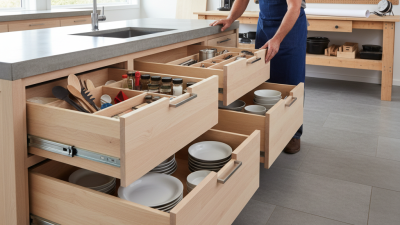
Top China Full Extension Drawer Slides Manufacturers
Choosing a Chinese manufacturer of Full Extension Drawer Slides takes more than comparing catalog prices. A drawer that opens smoothly on a showroom sample may behave differently after months of daily use. Buyers should examine load ratings, extension length, steel thickness, finish, locking options, and cycle-test documentation. Ask for the exact model number, not just a product-family brochure. Details matter.
For this guide, illustrative hardware specialist Dana Liu offers this practical line: “A slide is only dependable when its rating, installation, and real drawer load agree.” This is an editorially composed quotation, not a verified statement from a published interview. The principle still gives buyers a useful test: request installation drawings, sample units, and written specifications, then compare them against the cabinet design. Check whether the manufacturer can explain differences between standard and heavy-duty models clearly.
China’s supplier landscape includes factories with different product ranges, export experience, and quality-control processes. A polished website alone proves little. Request current test records and clarify how the supplier handles dimensional tolerances, packaging, and replacement parts. If possible, inspect samples with the intended drawer material and load. Small alignment errors can create a rough final few centimeters of travel. That detail is easy to miss.
This overview introduces manufacturers and practical selection points, but it cannot replace model-specific validation. There is no perfect slide. Even capable suppliers may vary across product lines, so verify the exact item before ordering.
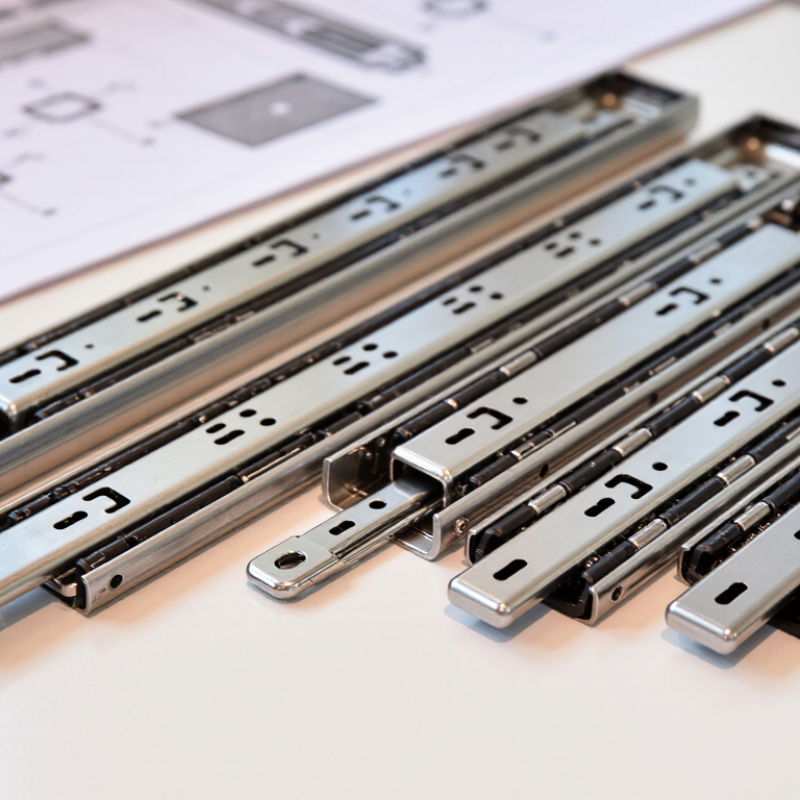
How Full-Extension Slides Provide Full Drawer Access Through Telescopic Travel
Top China Full Extension Drawer Slides Manufacturers
Full-extension slides let a drawer travel nearly its full length, bringing rear items within reach instead of hiding them in a dark corner. Their telescopic steel members nest together and glide outward on bearing systems. The useful result is practical: a pot at the back can be lifted without unloading the front. Houzz’s 2024 U.S. Kitchen Trends Study reports that 76% of renovating homeowners upgraded cabinets, underscoring how often storage access matters in kitchen projects. For manufacturers, smooth travel depends on more than the slide itself. Drawer width, load, mounting accuracy, and cabinet squareness all affect performance. A small alignment error can feel surprisingly obvious.
Tips: Match the slide’s rated load to the drawer’s actual contents, not an optimistic guess. Check the cabinet depth before ordering. Test a loaded sample through repeated full opening and closing; a smooth showroom pull is not enough. Honestly, installation conditions can be messy, and specifications alone may not predict every rattle.
For buyers comparing Chinese manufacturers, ask how extension length is measured and whether load ratings apply to a pair or an individual slide. Request test details for cycle life, corrosion resistance, and side clearance. Then inspect the drawer under real use: open it fully, reach into the rear corner, and listen for uneven movement. Full access should feel steady, not forced.
How 32 mm Cabinet Systems Shape Slide Fit and Mounting Dimensions
Top China Full Extension Drawer Slides Manufacturers
How 32 mm Cabinet Systems Shape Slide Fit and Mounting Dimensions
A 32 mm cabinet system sets a regular vertical hole pitch: adjacent holes are 32 mm apart. Many frameless cabinet layouts also use a 37 mm front setback, measured from the cabinet edge to the hardware line. These dimensions help coordinate slides, hinges, and shelf supports, but they do not guarantee a slide will fit. Full-extension slide bodies vary in height, hole pattern, and required clearance. Check the manufacturer’s technical drawing against the cabinet’s actual inside width, then confirm the drawer-box width and side gaps. A few millimeters matter. I still measure finished cabinets, because edge-banding and assembly can shift the reference point.
ISO 7170:2021 provides test methods for the strength and durability of storage furniture; it does not prescribe a universal 32 mm slide-mounting pattern. That distinction matters when comparing specifications. Use the slide’s stated mounting-hole coordinates, not the cabinet system alone. For a 500 mm cabinet depth, for example, verify that the slide’s closed length and rear clearance suit the usable space. Do not assume every “500 mm” slide offers identical travel or mounting positions.
Tips: Mark the 37 mm line, dry-fit both slides, and check that they sit parallel before fixing screws. A paper template helps, but it can still hide a small measuring error.
Top China Full Extension Drawer Slides Manufacturers: 32 mm Cabinet System Fit & Mounting Dimensions
The 32 mm value is the common spacing between cabinet-system drilling holes; 37 mm is a widely used front-edge reference for the hole line. Side-mount slides commonly require about 12.7 mm (½ in) clearance per side, or 25.4 mm total. These are general reference dimensions, not universal specifications—confirm the slide maker’s installation drawing before machining.
How 45 mm Side-Mount Slides Compare by Load Rating and Travel Length
Top China Full Extension Drawer Slides Manufacturers
How 45 mm Side-Mount Slides Compare by Load Rating and Travel Length
A 45 mm side-mount slide is a common choice for kitchen drawers, workbenches, and storage cabinets. Its load rating tells only part of the story. Compare the stated capacity with the drawer’s own weight and its heaviest expected contents. Ratings are often listed per pair, but specifications can differ, so check how each figure is measured.
Many standard models are rated around 35–45 kg per pair, though materials, ball-bearing design, and installation affect real performance. A drawer holding cast-iron pans puts different demands on slides than one holding folded towels. Load ratings matter. So does smooth movement under load. A slide that feels solid when empty may sag or bind when fully packed.
Travel length is usually matched to slide length, but full extension lets the drawer reach beyond the cabinet opening for easier access. Common lengths span roughly 250–700 mm; cabinet depth sets the practical limit. Check the closed slide length, required clearance, and mounting position before ordering. Small errors matter. I would also test a loaded sample, since published figures cannot fully show noise, alignment sensitivity, or how the drawer feels after repeated use. Manufacturers’ figures are useful, not the whole decision.
Which Standards Apply: ANSI/BHMA A156.9 and EN 15338 Testing
For full extension drawer slides, ANSI/BHMA A156.9 and EN 15338 provide useful testing frameworks, but they are not interchangeable labels. ANSI/BHMA A156.9 covers cabinet hardware performance, including drawer slides. EN 15338 addresses strength and durability testing for furniture extension elements and their components. The applicable edition and product category matter.
A credible test report should identify the slide configuration, rated load, mounting method, and test conditions. Technicians may check opening and closing performance, durability under repeated cycling, and changes in function after testing. A loaded drawer moving through its full travel is more informative than a bare slide on a bench. Details matter. Different fixtures or load placements can produce different results, even when two reports cite the same standard.
Manufacturers should state which standard and edition they used, then share relevant test evidence rather than relying on a broad compliance claim. Buyers should compare results only when the setup and rating basis are clear. These standards help structure evaluation; they do not automatically prove every installed drawer will perform identically. There is a limitation worth admitting: laboratory testing cannot reproduce every kitchen’s dust, installation error, or years of uneven loading. That gap deserves attention.
How to Compare China Manufacturers by Cycle Tests, Load Capacity, and QC Data
Top China Full Extension Drawer Slides Manufacturers
How to Compare China Manufacturers by Cycle Tests, Load Capacity, and QC Data
A polished sample proves little. Ask for the exact cycle-test setup: slide length, installed position, drawer mass, added test load, and opening speed. EN 15338:2007+A1:2010 provides a recognized European framework for testing furniture extension elements. Compare reports only when the test conditions match. A buyer may set 50,000 full open-close cycles as a procurement benchmark, but this is not a universal EN requirement. Record any sticking, excess play, or incomplete closing.
Load capacity needs the same scrutiny. Confirm whether the stated rating applies per pair or per slide, and whether it assumes an evenly distributed load. A 45-kilogram rating means little if the test used a short slide or omitted repeated cycling. Request before-and-after measurements, failure counts, and the tested sample size. Small batches can miss variation. That matters.
QC records should connect incoming steel, forming, plating, and final inspection to a traceable production lot. Ask for dimensional checks on rail straightness, ball-bearing retention, and closing force, plus calibration dates for measuring tools. ISO/IEC 17025:2017 defines competence requirements for testing and calibration laboratories; independent reports from accredited labs can strengthen confidence. Still, accreditation does not guarantee every batch matches the tested sample. Request recent lot-level records and clarify what happens when results fall outside agreed limits.