Leave Your Message
Choosing Heavy Duty Drawer Slides for global sourcing is not simply a matter of selecting the highest load rating. A slide may support 200 kilograms in a factory test, yet perform poorly inside a dusty cabinet or uneven steel frame. Real sourcing decisions require context. Drawer weight, extension length, mounting space, operating frequency, and installation accuracy all matter. Small gaps can create noise, binding, or premature wear.
Experienced buyers usually begin with a clear technical specification. It should define static and dynamic load capacity, slide length, travel, material, finish, locking requirements, and expected cycle life. Stainless steel may suit humid environments, while zinc-plated steel can offer a practical balance for indoor equipment. Ask suppliers for test reports, dimensional drawings, material details, and traceable samples. Then test the samples under realistic conditions, including repeated opening, vibration, and uneven loading.
Supplier evaluation also deserves careful attention. Review production capability, quality controls, packaging methods, and experience with export shipments. A polished catalog is not proof of consistent production. Visit the factory when possible, or use an independent inspection service. Confirm that the approved sample matches mass production.
No checklist is perfect. I have seen attractive prices hide weak packaging and inconsistent tolerances. That assumption can be costly. Buyers should compare total landed cost, not only the unit price. Freight, damage, replacement parts, installation time, and rejected goods can quickly change the calculation. A disciplined process makes Heavy Duty Drawer Slides more reliable across markets, applications, and supply cycles.
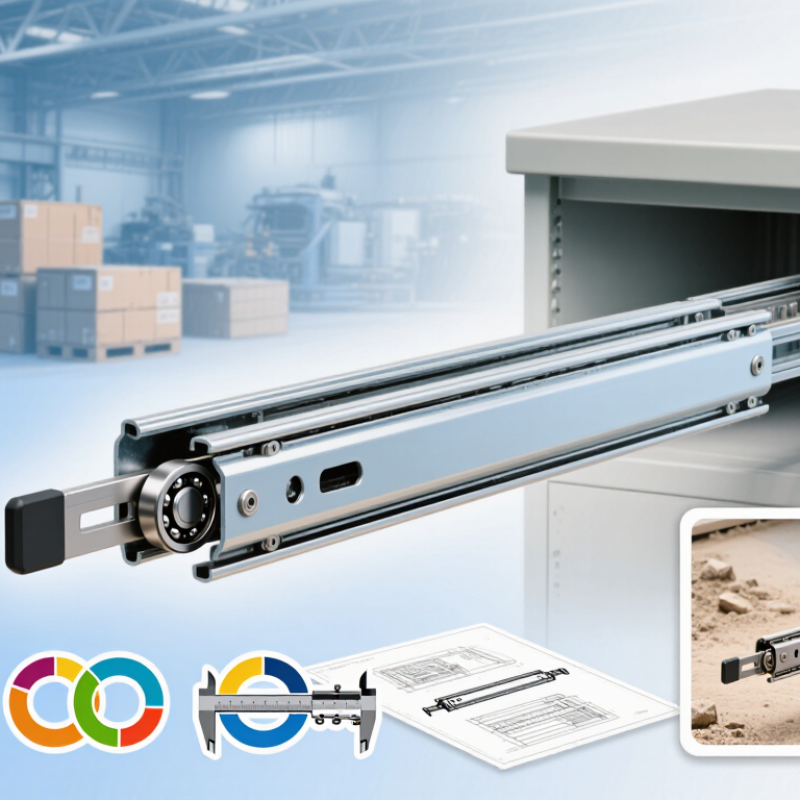
For global sourcing, heavy duty drawer slides should be selected from measured loads, not catalog labels. Start by weighing the drawer, hardware, and maximum contents separately. Add a safety margin, usually 20–30%, when storage conditions are stable. Higher margins may help with tools, kitchen equipment, or frequent impact. Record whether the load is centered or pulled toward the front. A front-heavy drawer creates more leverage and can reduce slide life. It happens often. Define extension: three-quarter, full, or over-travel. Then note cabinet depth, drawer width, and side clearance. A few millimeters can determine whether installation feels precise or frustrating.
Specify mounting orientation, closed length, extension length, and required travel. State the rated load at a clear testing position, such as a fully extended drawer. Some suppliers quote static capacity only, while real use includes opening cycles and uneven loading. Ask for cycle-test data, deflection limits, and installation tolerances. Steel thickness, bearing design, finish, and lock requirements also matter. For humid warehouses or coastal routes, confirm corrosion resistance through documented testing. Avoid relying on vague wording. Drawings prevent many sourcing errors. Still, drawings can hide assumptions. Verify hole patterns, screw sizes, and carton protection with a sample before approving volume production.
Tips: Build a simple load sheet for each drawer size. Include empty weight, contents, safety margin, extension, and environment. Test a loaded sample repeatedly. A quiet slide is not always durable. Recheck performance after dust, vibration, and minor misalignment.
| Data Dimension | Recommended Specification or Range | Typical Heavy-Duty Application | Global Sourcing Requirement | Selection and Verification Notes |
|---|---|---|---|---|
| Rated Load Capacity | Approximately 45–113 kg (100–250 lb) per pair, depending on slide design and extension length. | Tool cabinets, industrial storage drawers, machine enclosures, service vehicles, and equipment cases. | Request the rating in both kilograms and pounds, and specify whether it applies to a pair of slides or to one slide. | Do not select by product name alone. Confirm the test method, mounting orientation, extension length, and allowable deflection with the supplier. |
| Calculated Working Load | Drawer mass + contents + attached hardware. Add a project-defined allowance for impact, vibration, and uneven loading. | Drawers containing dense tools, metal components, batteries, electrical parts, or maintenance equipment. | Provide the empty drawer weight, maximum content weight, center of gravity, and expected operating conditions in the RFQ. | Use the maximum operating load rather than the average load. A safety allowance should be defined by the project engineer or applicable standard. |
| Load Distribution | Preferably centered and evenly distributed across the drawer base. | Wide drawers, long trays, and storage units with mixed-size contents. | State whether the load is centered, front-loaded, side-loaded, or subject to repeated shock. | Front-loaded or off-center loads increase leverage and may require a higher-rated slide or additional structural support. |
| Extension Type | Partial extension, approximately 70–80%; full extension, approximately 100%; over-extension, more than 100% where available. | Partial extension for compact storage; full extension for complete access; over-extension for deep cabinets or rear equipment access. | Specify closed length, open length, usable travel, and whether the drawer must clear the cabinet front. | Longer extensions generally increase bending and deflection demands. Confirm the load rating at the required extension length. |
| Slide Length | Common industrial sizes are approximately 300–1000 mm, subject to the supplier's product range. | Small equipment drawers through deep industrial cabinets and vehicle-mounted storage systems. | Specify nominal slide length, installation tolerance, and the required relationship between slide length and drawer depth. | The slide should be supported along the intended mounting area. Avoid selecting a slide longer than the available cabinet depth. |
| Side Clearance | A common side-mount requirement is approximately 12.7–19.0 mm per side, but the exact value is model-specific. | Metal and plywood drawers using side-mounted telescopic slides. | Provide cabinet opening width, drawer outside width, material thickness, and the permitted installation tolerance. | Clearance that is too small can cause binding; excessive clearance can reduce stability and increase side play. |
| Mounting Orientation | Side mounting is common for heavy-duty drawers; bottom or horizontal mounting requires a rating specifically approved for that orientation. | Side-mounted industrial drawers, platform trays, and specialized equipment compartments. | Include a drawing showing mounting faces, screw locations, bracket positions, and cabinet obstructions. | A vertical side-mount rating should not automatically be applied to a horizontal application. |
| Slide Member Design | Three-member telescopic construction is widely used for full-extension heavy-duty applications. | High-load drawers requiring access to the rear of the drawer. | Request the number of members, member thickness, bearing or roller arrangement, and exploded construction drawing. | Member geometry and steel thickness affect stiffness, travel, load capacity, and resistance to racking. |
| Material and Finish | Cold-rolled or stainless steel construction; common finishes include zinc plating, electrophoretic coating, or other corrosion-resistant treatments. | Indoor industrial equipment, workshops, outdoor cabinets, transport equipment, and humid environments. | Specify base material, coating type, coating thickness if controlled, salt-spray requirement, and restricted-substance requirements. | Corrosion performance depends on the complete system, including cut edges, fasteners, humidity, chemicals, and cleaning methods. |
| Locking Function | Optional hold-in, hold-out, detent, or lock-in/lock-out mechanisms. | Mobile cabinets, service vehicles, rail equipment, and machinery exposed to vibration or tilting. | Define the locked position, release method, release force, vibration conditions, and required retention direction. | A retention feature is not a substitute for a separate cabinet-level anti-tip system when multiple drawers may be opened. |
| Operating Environment | Define temperature, humidity, dust, water exposure, chemicals, vibration, and installation altitude before selection. | Factory floors, warehouses, outdoor enclosures, vehicles, marine-adjacent areas, and clean equipment rooms. | List minimum and maximum operating temperatures, cleaning chemicals, ingress exposure, and transport conditions. | Choose stainless steel or enhanced corrosion protection when humidity, salt, or chemical exposure exceeds normal indoor conditions. |
| Cycle Life | Set a project target, such as 10,000, 20,000, or more operating cycles, based on product service life. | Frequently accessed tool storage, production-line stations, and fleet maintenance equipment. | Request the cycle-test load, speed, extension length, lubrication condition, failure criteria, and test report. | Cycle-life results are meaningful only when the test conditions represent the intended installation and operating load. |
| Mounting Hardware | Fastener size, head style, thread type, hole pattern, and bracket design must match the cabinet and drawer structure. | Welded steel cabinets, aluminum housings, plywood drawers, and modular equipment frames. | Specify fastener standard, torque requirement, hole tolerance, included accessories, and installation tooling. | The mounting structure and fasteners must be capable of carrying the slide load; slide capacity alone does not determine system capacity. |
| Dimensional Tolerance | Control cabinet squareness, parallelism, vertical alignment, and side clearance according to the supplier's installation limits. | Production cabinets and replacement programs requiring consistent interchangeability. | Request a dimensional drawing with critical tolerances and a first-article inspection plan. | Misalignment can cause high operating force, uneven wear, premature failure, and reduced load performance. |
| Quality Documentation | Technical drawing, material declaration, inspection report, load test data, corrosion test data, and change-control records where applicable. | Regulated industries, OEM programs, safety-sensitive equipment, and repeat international purchasing. | Include document revision, sample approval, batch traceability, packaging specification, and pre-shipment inspection criteria. | Use approved samples and written specifications to prevent unannounced changes in steel grade, finish, dimensions, or load rating. |